AI is rapidly changing how ERP systems are extended, and Odoo is no exception. One particularly promising direction is the emergence of smart, data-aware assistants—AI systems that can understand natural language while responding with real, up-to-date business data.
This article explores an experiment in that space: creating a smart shop assistant for Odoo using Retrieval-Augmented Generation (RAG)—without writing custom code. The entire solution is built using N2, an experimental, node-based addon that enables AI workflows directly inside Odoo.
AI Workflows Inside Odoo with N2
N2 is a community-driven project that brings node-based AI orchestration into Odoo. Instead of developing complex Python logic or external services, developers and functional users can visually compose AI workflows using connected nodes.
These graphs define how data is fetched, transformed, stored, and queried—making advanced AI patterns accessible even in low-code or no-code environments.
One of the most powerful patterns supported by N2 is Retrieval-Augmented Generation (RAG).
Why RAG Is Essential for Smart Assistants
Traditional chatbots generate answers based solely on their training data, which often leads to vague or incorrect responses. RAG changes this by grounding the AI’s answers in real business data.
In an e-commerce context, this means the assistant can answer questions like:
“What’s the description of the blue widget?”
by retrieving the exact product information stored in Odoo before generating a response. The result is higher accuracy, fewer hallucinations, and greater trust from users.
RAG without Coding: New N2 AI Nodes
This experiment introduces four new nodes in the N2 AI module, specifically designed to enable RAG workflows—entirely through configuration, not code:
Create Memory Node – Stores product information as searchable AI memory.
Embedding Function Node – Converts text into vector embeddings automatically.
Search Memory Tool Node – Performs semantic searches over stored memories.
AI Data Tool Node – Retrieves additional Odoo fields dynamically when needed.
Together, these nodes make it possible to build a production-ready RAG pipeline using visual graphs alone.
Turning Product Data into AI Memory
At the heart of the assistant is a vector-based memory built from Odoo product data. Product records are retrieved using standard N2 data nodes and transformed into memory entries that the AI can search semantically.
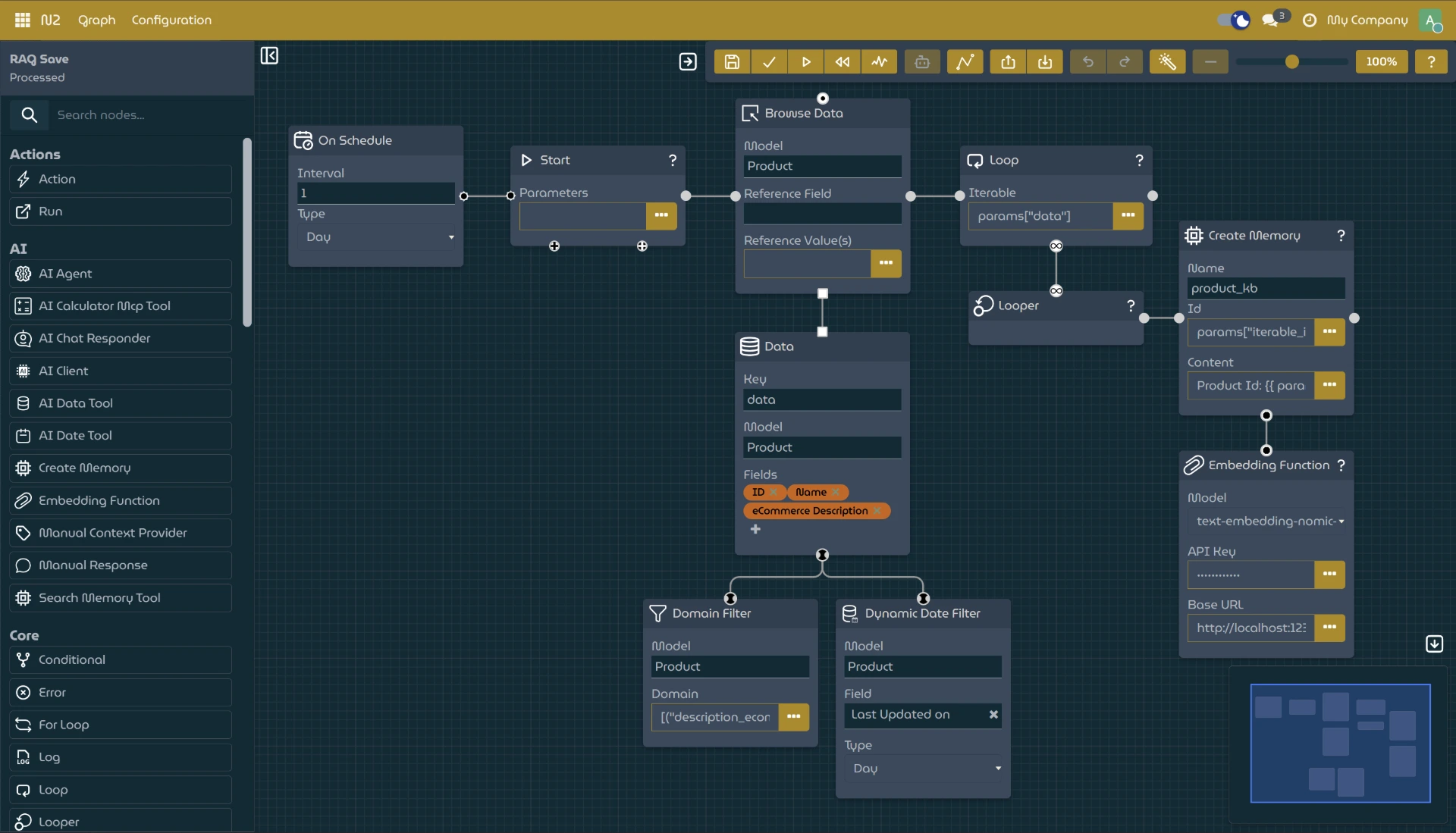
To keep the system efficient and safe, only essential fields are indexed:
Product ID
Product name
E-commerce description
The memory is kept up to date automatically through scheduled triggers, ensuring the assistant always reflects the latest product information—without manual intervention.
A Smart Shop Assistant That Understands Your Data
Once the product memory exists, a separate AI agent graph powers the shop assistant itself. When a customer asks a question, the assistant:
Searches product memory using semantic similarity
Selects the most relevant product context
Retrieves additional public-facing fields (such as pricing or sales descriptions) only when required
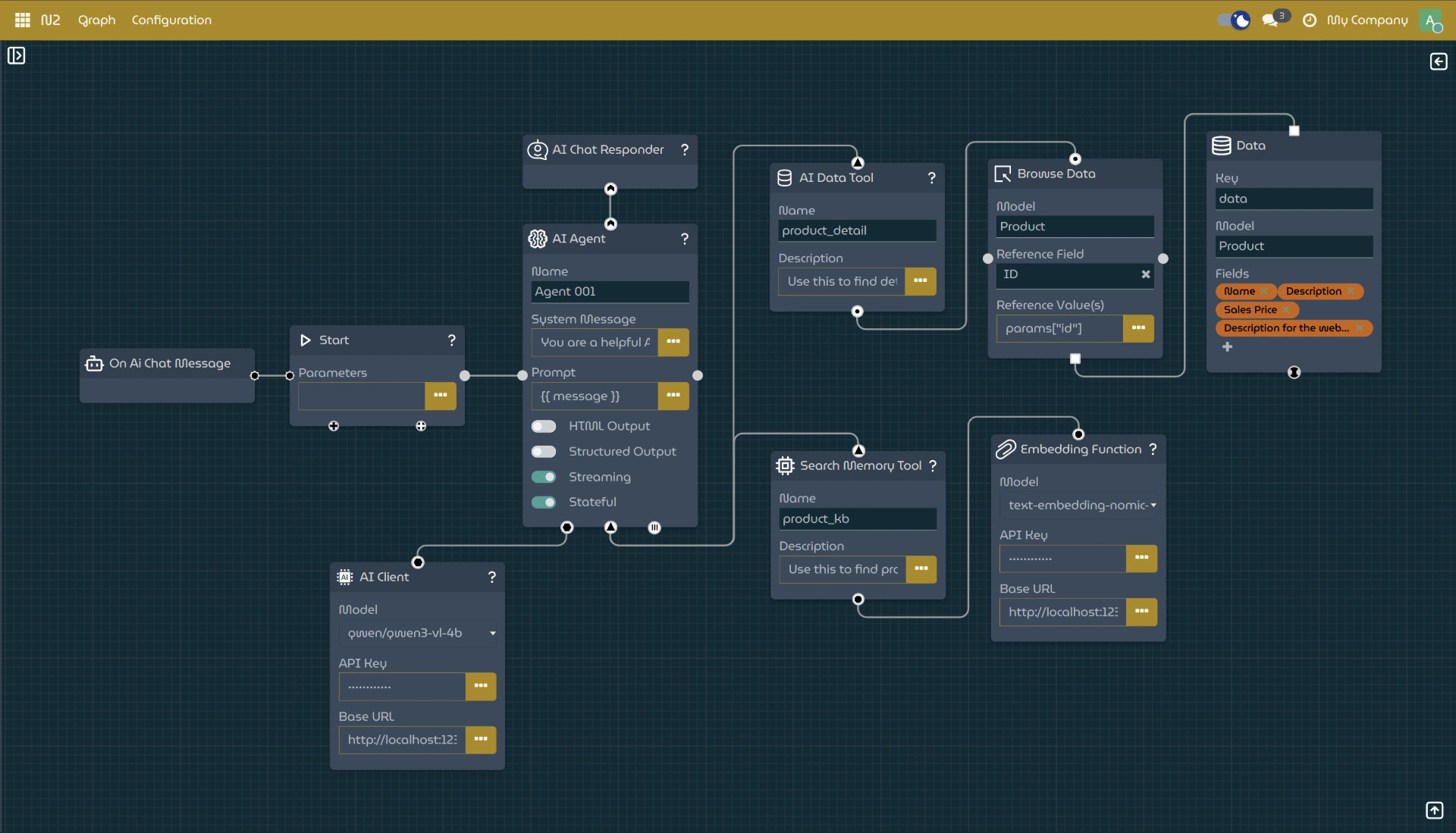
Because everything is defined visually in N2, expanding or refining the assistant’s behavior becomes a matter of adjusting nodes—not rewriting code. At the same time, strict boundaries ensure that sensitive or internal data is never exposed to public users.
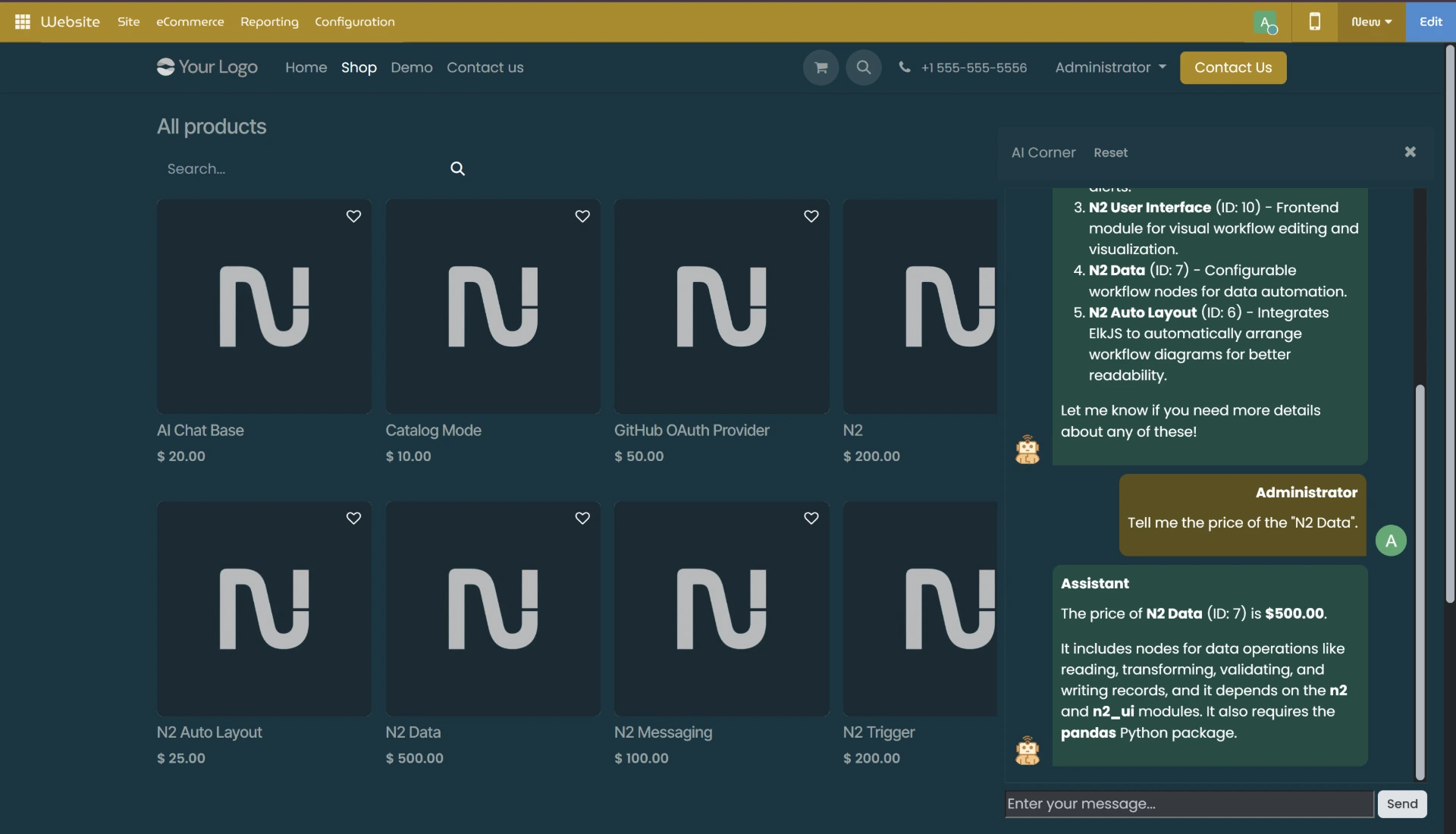
What This Enables for Odoo
The result is an assistant that feels conversational while behaving like a precise data query system. It demonstrates how advanced AI concepts like RAG can be applied inside Odoo in a low-code, transparent, and maintainable way.
More broadly, this approach shows how node-based AI tools like N2 can democratize AI development in ERP systems—allowing functional consultants, implementers, and developers alike to build smarter features without deep AI expertise.
For those interested in exploring further, the N2 website resources include source code, documentation, and additional experiments built around N2.
Have you tried building AI assistants in Odoo or other ERP platforms—especially without writing code? This space is evolving fast, and the possibilities are just getting started.